Authority and Submission: Power Rendered in Line
How artists across centuries used graphite and ink to document hierarchies, violence, and the machinery of control.
“Artists using graphite to represent themes of oppression and power”
Power is most clearly visible at the moment of its exercise: the ruler on horseback, the subject bowing, the prisoner led to execution, the body in chains. This exhibition gathers drawings and works on paper from the 16th century to the early 20th century where artists used graphite, ink, and their precise linear vocabulary to record the postures and rituals through which authority asserts itself. The works span Mughal courts and European traditions, yet a common thread runs through them: the human figure reduced to a formal arrangement, the body arranged to demonstrate submission or domination. Some artists were court painters documenting imperial ritual as propaganda. Others were later observers or critics, recording violence and subjugation with the cold clarity that line allows. What unites them is the belief that graphite and ink could capture something essential about power that paint or color could not: the skeleton of hierarchy itself.
The Mughal miniatures form the exhibition's largest group, and deliberately so. These works were created within courts where the artist's task was to visualize the ruler's authority through carefully composed scenes of ceremony, sport, and judicial authority. The king feeds the lady fruit from the Tree of Life. The elephant is captured at the emperor's command. The holy man prostrates before the prince. Gold leaf marks the space of power; graphite and ink outline the bodies that occupy it. Yet even within this courtly propaganda, we see moments of coercion: executions, punishments, judgments rendered. The second movement of the show turns to European artists of the 19th and early 20th centuries who borrowed these same strategies to depict moral hierarchy, battle, and political resistance. By the mid-19th century, the medium becomes a tool for both celebration and critique: artists use graphite and ink to document slavery and war with an almost journalistic plainness.
This is not an exhibition about beauty or virtuosity in drawing, though many of these works possess both. It is about the specific power of line to create readable hierarchies, to show us command and submission at a glance. When an artist draws a figure on bended knee or an emperor elevated on horseback, they are not inventing a visual language; they are inheriting one that has worked for centuries to make power visible and, in being visible, to make it seem natural.
Walk through in order, 15 works.
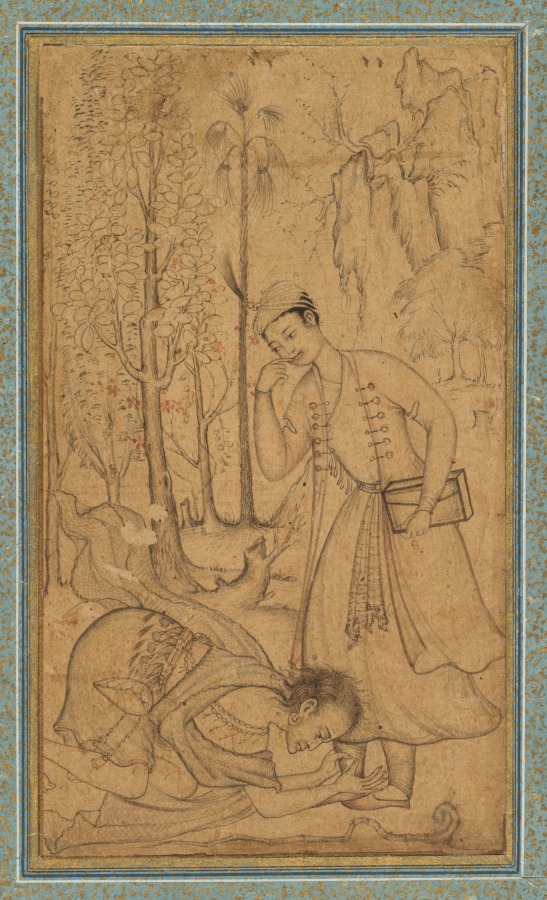
A holy man prostrating himself before a learned prince
The holy man's bowed spine and lowered head, outlined in dark ink against gold borders, establish the visual grammar of submission that the exhibition traces across centuries.
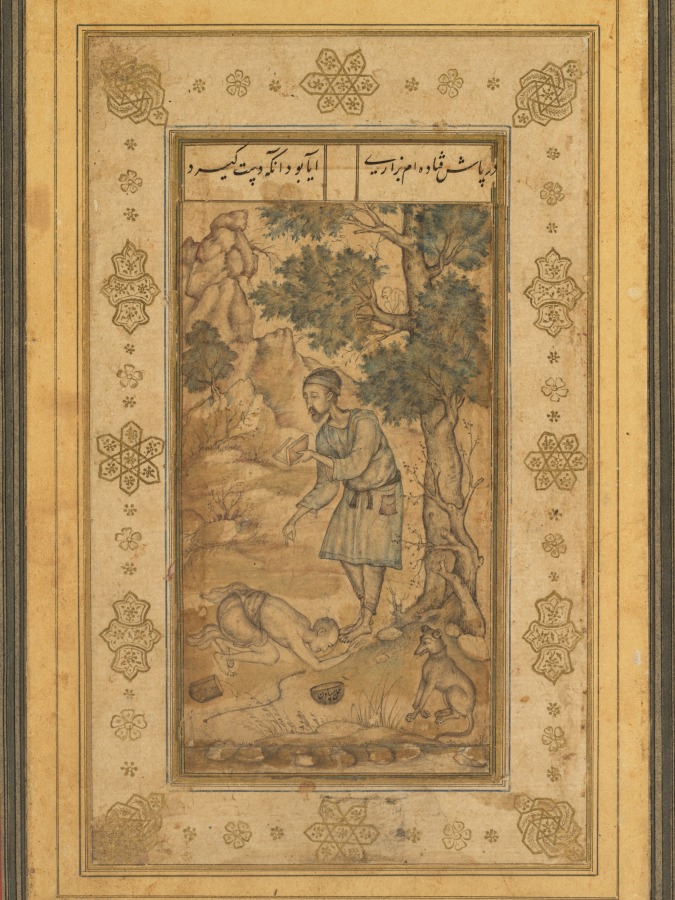
A mendicant bowing before a holy man, from the Prince Salim Album
A mendicant's gesture of deference becomes readable through ink line alone; the pose works as formal statement before it means anything spiritual.
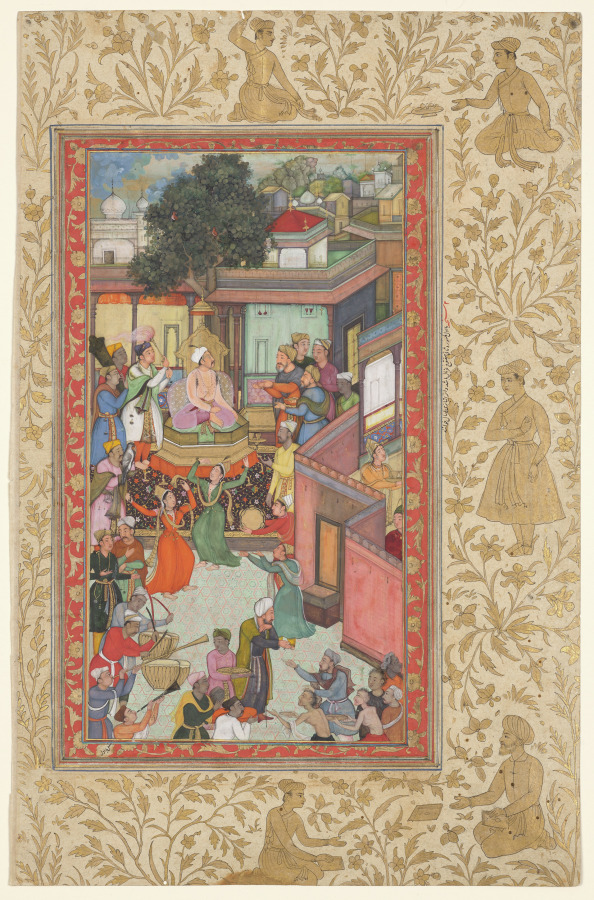
Circumcision ceremony for Akbar’s sons, painting 126 from an Akbar-nama (Book of Akbar) of Abu’l Fazl (Indian, 1551–1602)
The circumcision ceremony depicted here places the ruler's sons within an elaborate architectural and hierarchical space where ink and gold work together to mark status and authority.
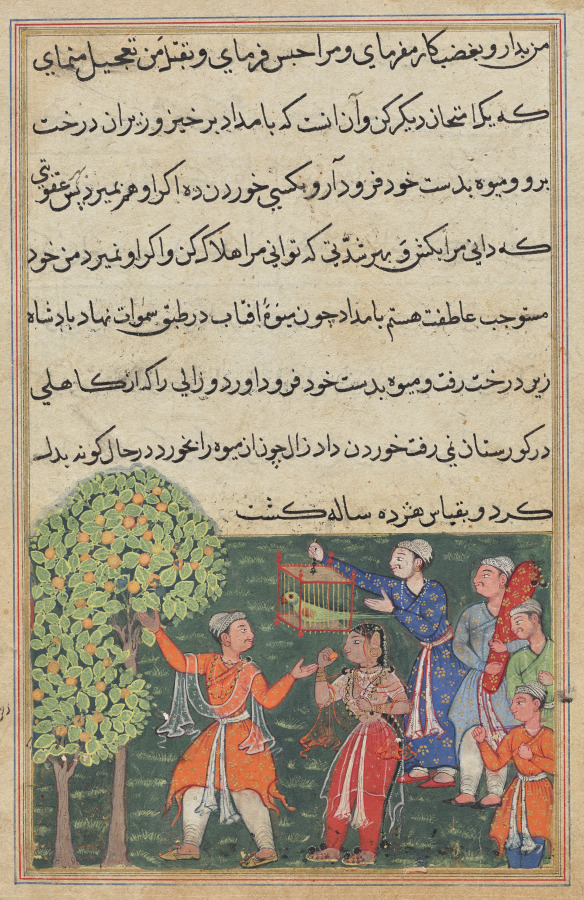
The king plucks fruit from the Tree of Life with his own hands and feeds it to a lady, from a Tuti-nama (Tales of a Parrot): Ninth Night
The king's raised hand and commanding posture as he feeds fruit to the lady are rendered through linear composition; power is shown as a controlled, deliberate action rather than accident.
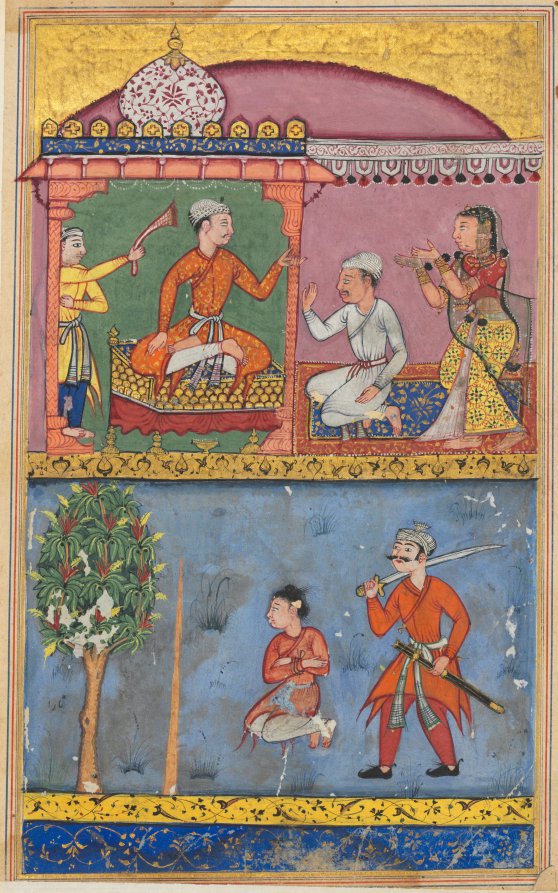
The handmaiden appeals for justice and the prince is taken to the execution site for the fourth time, from a Tuti-nama (Tales of a Parrot): Eighth Night
The prince awaits execution in a scene organized by ink line into registers of judgment and consequence; the composition itself becomes a visual argument about judicial power.
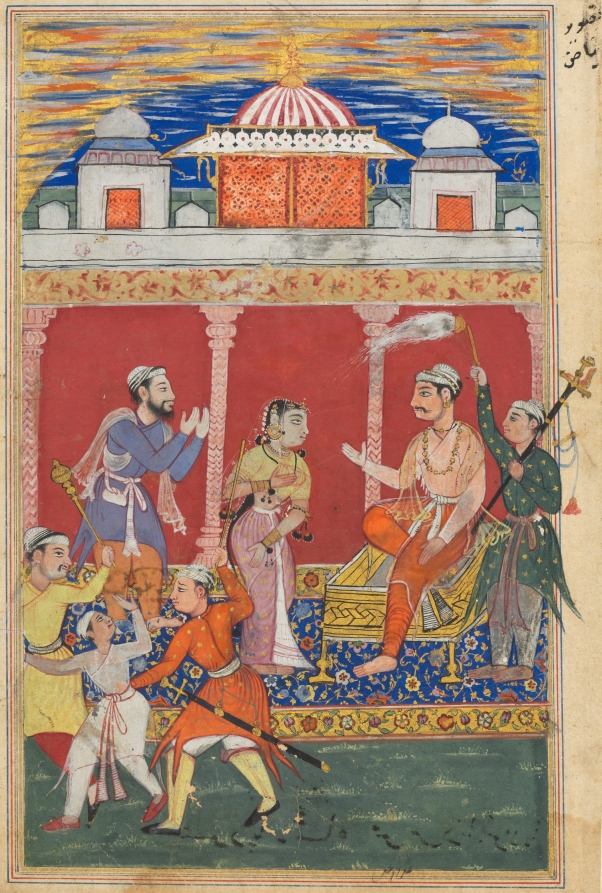
The prince’s ordeal continues, he is ordered away to be executed for the fifth time, from a Tuti-nama (Tales of a Parrot): Eighth Night
The repeated threat of execution unfolds through multiple registers separated and clarified by ink outlines; the drawing technique mirrors the formal, ritualized nature of state violence.
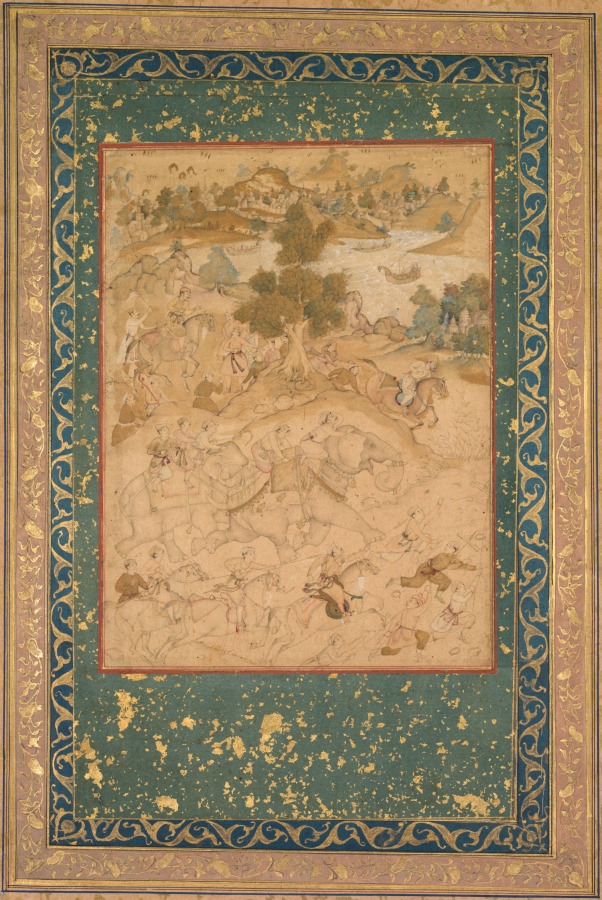
Akbar supervising the capture of wild elephants at Malwa in 1564, painting 90 from an Akbar-nama (Book of Akbar) of Abu’l Fazl (Indian 1551–1602)
Akbar's elephants are being captured at his command, their bodies outlined and arranged to demonstrate imperial mastery over animal and landscape through the precise coordination that ink allows.
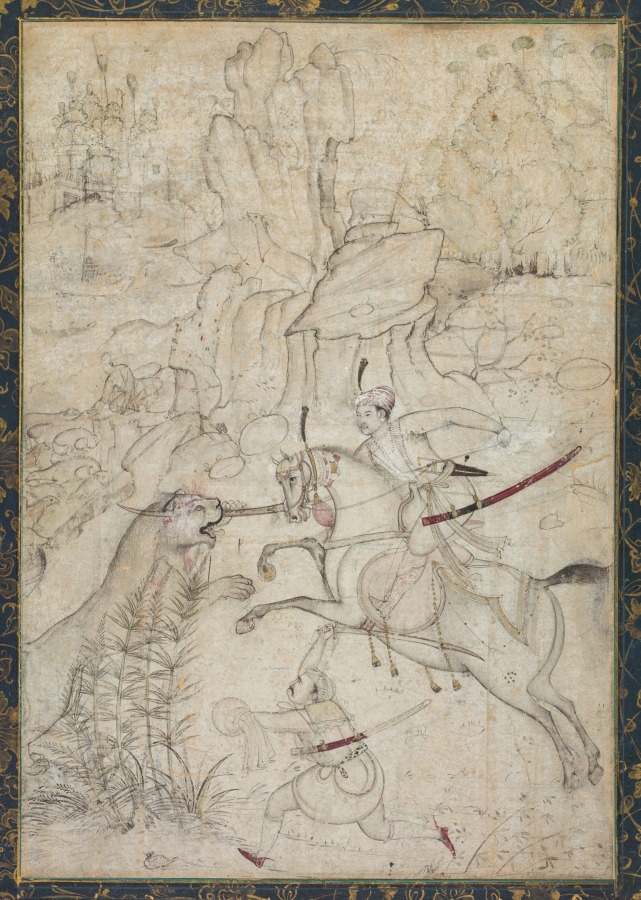
A Mounted Prince Hunting Lion in a Rocky Landscape
A mounted prince dominates the composition through line and diagonal thrust; the horse and hunter become a single hierarchical form rendered in ink and gold.
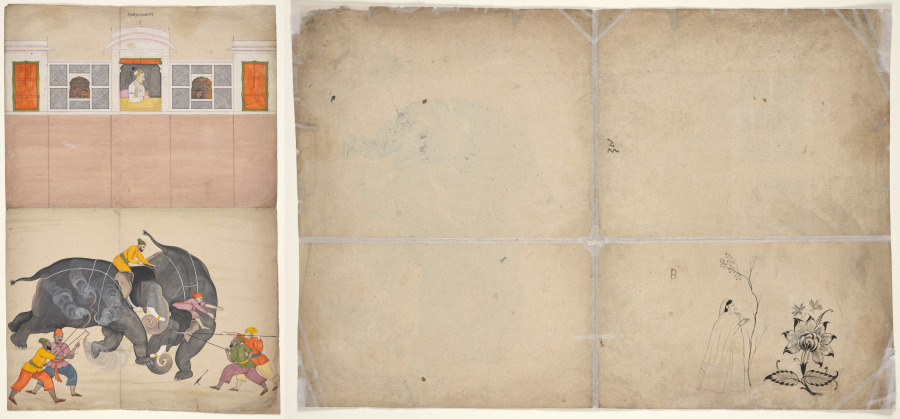
Two Elephants Fighting in a Courtyard Before Muhammad Shah
Two elephants clash in a courtyard watched by the ruler; the scene is organized through ink outlines that keep the imperial viewer separate from and elevated above the violent action.
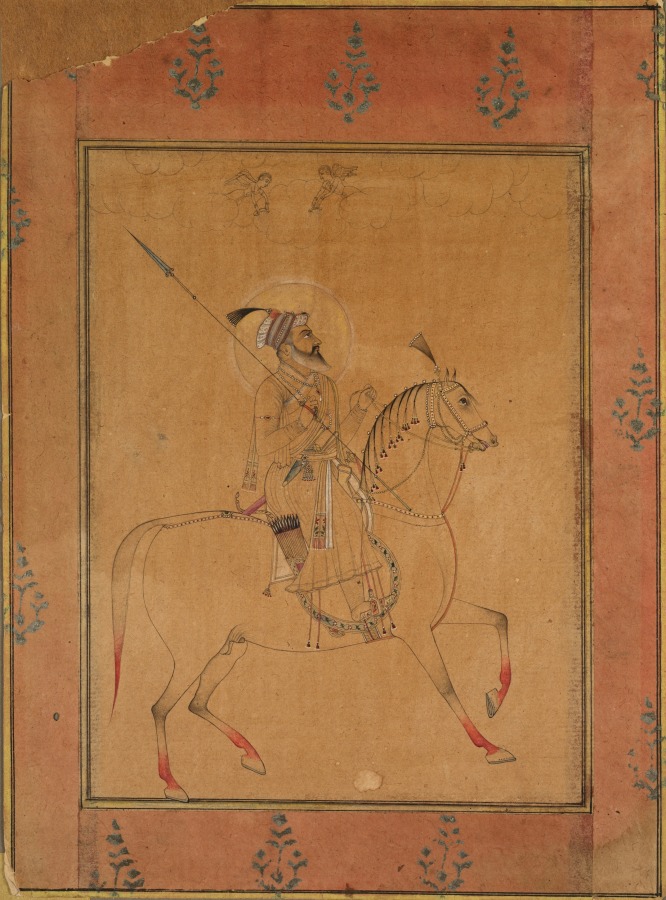
Emperor Shah Jahan
Shah Jahan's profile is rendered with studied restraint in ink and tempera; the formal elegance of the drawing technique itself becomes a statement of imperial authority and control.
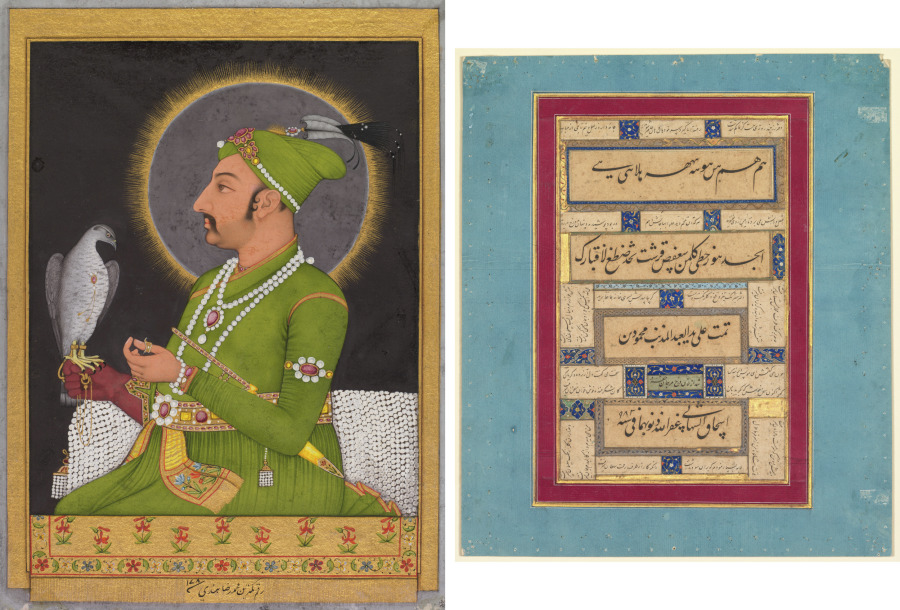
Posthumous portrait of the Mughal emperor Muhammad Shah (reigned 1719–1748) holding a falcon (recto); Calligraphy (verso)
The posthumous portrait of Muhammad Shah holding a falcon demonstrates how ink and gold continue to mark rulership even after death; the body and its attributes remain readable as power.
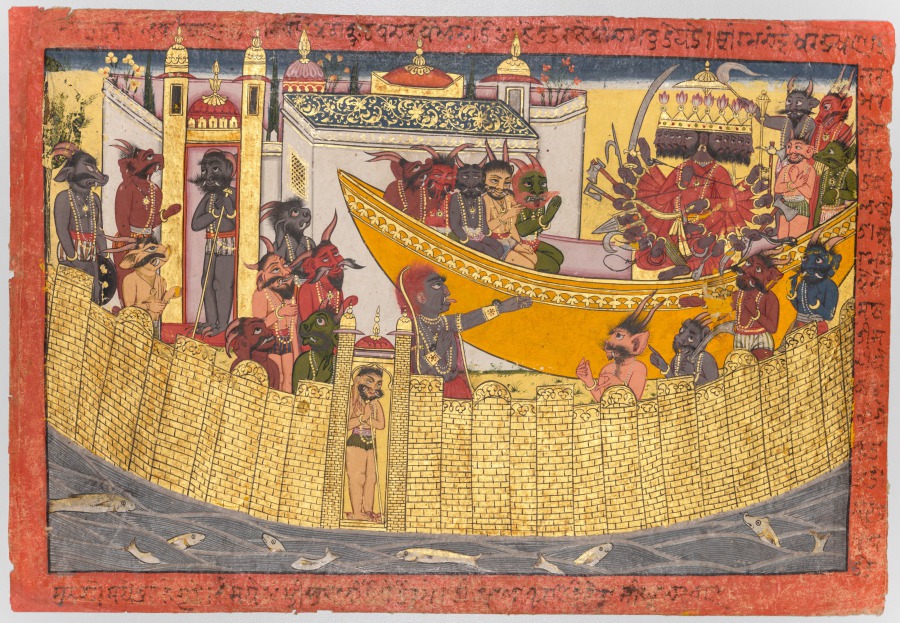
Shurpanakha demands vengeance, from the "Shangri" Ramayana
Shurpanakha's demand for vengeance unfolds across multiple figures and architectural spaces organized by ink line; the composition renders political and personal grievance as formal hierarchy.
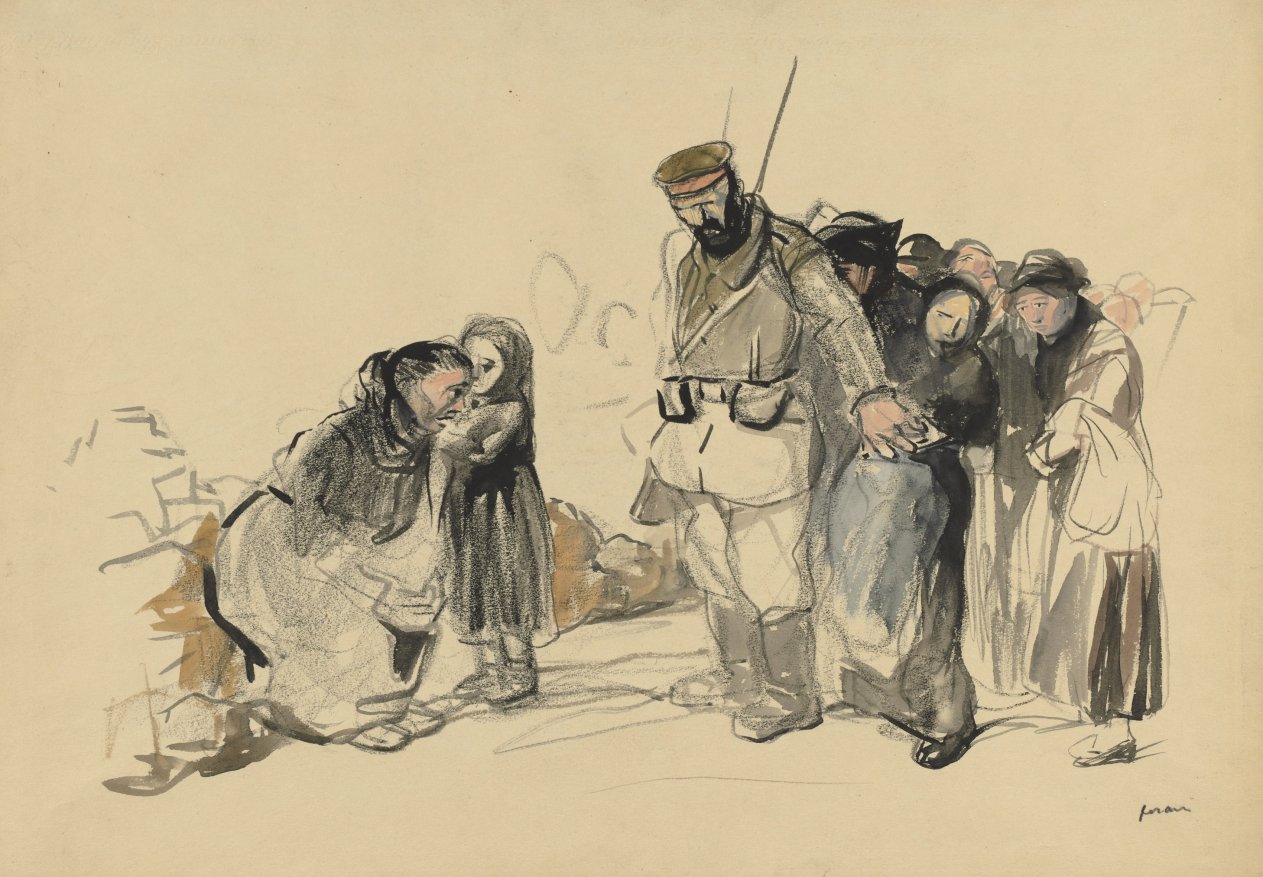
The Slavery in the North
Forain's crayon and gouache create a scene of northern slavery where the medium's starkness refuses the distant elegance of courtly drawing; submission is shown as brutality rather than ritual.
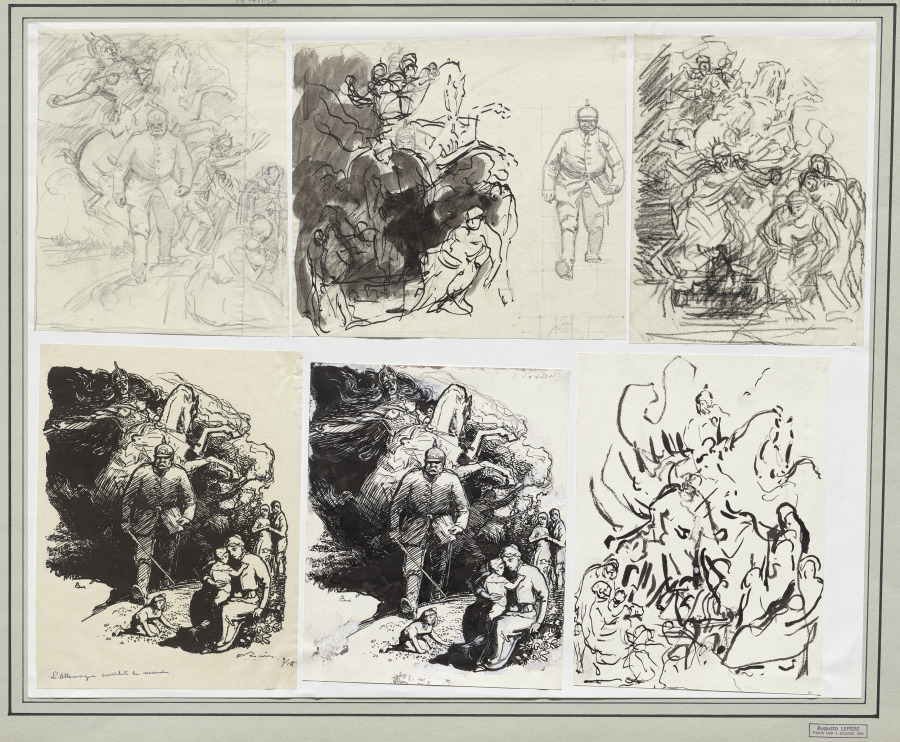
L'Allemagne envahit le monde
Lepère's black crayon studies for a propaganda print about German invasion layer multiple rapid sketches; the unfinished quality emphasizes the medium's capacity to document violence and chaos as it unfolds.
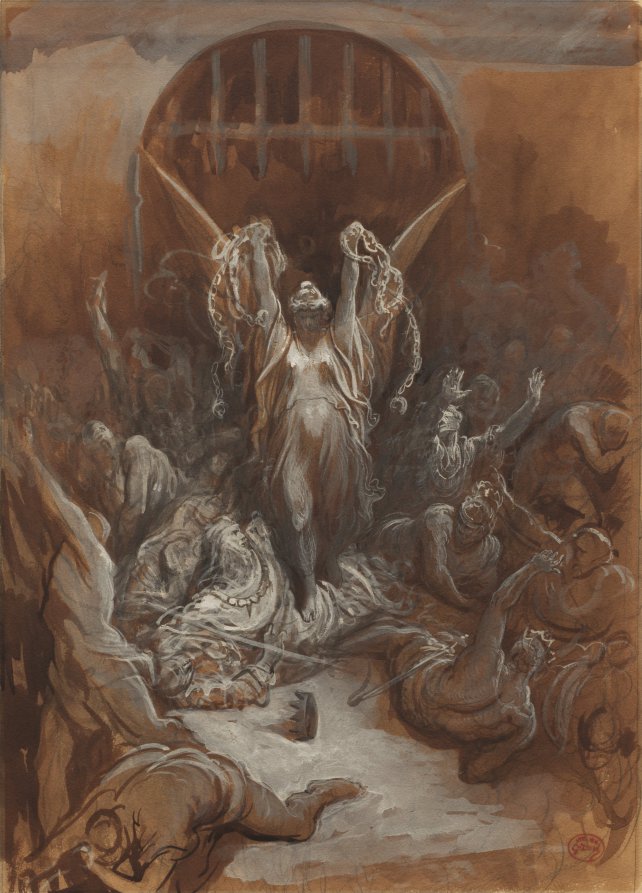
Liberty
Doré's Liberty is rendered in brown wash and white gouache with graphite in a composition where a central female figure raises her arms in a space crowded with suppliants and worshippers; the drawing technique creates depth through tonal gradation rather than linear hierarchy alone.
The Review

The exhibition opens with a simple and historical fact: for centuries, the line has been the most efficient tool for showing who commands and who submits. A bowed spine reads faster than a written law. A horse elevated above ground tells more about power than a thousand words about empire. These fifteen works, drawn from the Cleveland Museum's collection, make that argument with the patience and precision the argument deserves.
The Mughal miniatures that anchor this show are not being shown here as exquisite objects to be admired for their technique or their gold leaf, though the technique is real. They are being shown as documents of a visual language for power that still circulates. When Manohar draws a holy man prostrating before a learned prince in 1580, the ink line does a specific job: it makes the submission legible, absolute, and natural-looking. The posture reads instantly. The hierarchy requires no explanation. Five centuries later, this same visual vocabulary persists, adapted but recognizable, in how photographs compose rulers and the ruled, in how architecture still places the powerful above and the powerless below.
What strikes most forcefully is how consistently, across these Mughal works, violence or the threat of it appears not as chaos but as formal, organized, almost choreographed action. In "The handmaiden appeals for justice and the prince is taken to the execution site for the fourth time," from the Tuti-nama series, the multiple registers of the composition serve the same function as the architectural layering in a Mughal palace: to create a visual space where each body knows its place. The prince appears again and again awaiting execution, and each repetition is clarified through ink outline. This is not disorder; it is ordered punishment, made readable and therefore made to seem inevitable.
By the time Forain is drawing "The Slavery in the North" in 1852, the medium has not changed much, but its use has. His figures are rendered in black crayon and gouache with deliberate plainness; the composition refuses the gold leaf and architectural framing that elevated Mughal rulers. Instead, the drawing makes submission visible as physical degradation. This is still line at work, but line in service of exposure rather than justification. The distance between these two uses of the same formal vocabulary is not a distance of aesthetic choice; it is a distance of political intention.
Yet the exhibition does not resolve into a simple narrative of resistance or progress. Doré's "Liberty," rendered in wash and graphite around 1860, shows a female allegorical figure surrounded by supplicants, arms raised in triumph or invocation. The composition creates a different kind of hierarchy: one in which the figure of freedom is elevated not through imperial ritual but through spiritual or revolutionary fervor. The brown wash creates atmospheric depth, the white gouache lifts certain figures into visibility. But the fundamental structure persists: there is a center, and around it there are those who bow, who look up, who subordinate themselves to an idea made visible as form. Whether that idea is an emperor or liberty matters, historically and politically. But formally, visually, the grammar is inherited.
The exhibition's greatest strength lies in its refusal to sentimentalize any of this. The wall text does not suggest that showing these hierarchies critically somehow undoes them. Forain's drawing is not presented as redemption; it is presented as another use of the same tool. By doing this, the show acknowledges something that many historical exhibitions avoid: that we do not escape the visual languages we inherit by becoming aware of them. We live inside them, reproduce them, adapt them. The line that once elevated an emperor at his hunt still organizes how we see authority and power. Knowing that does not neutralize it.
What the show does not quite pursue is the question of how contemporary practice still relies on these forms, or how contemporary resistance might look if it genuinely refused them. The jump from Lepère's black crayon sketches of German invasion in 1914 to the Mughal court leaves a century and a half of visual culture unexamined. That gap is not a failure of curation so much as a limitation of the archive; the Cleveland Museum's collection may simply not contain the works that would make that argument visible. But it is worth noting as a point where the exhibition's reach exceeds its grasp.
The works here are beautiful, many of them, but beauty is not the point. The point is clarity of hierarchy, readability of power, the way a single line can do the work of legislation. This exhibition demonstrates that principle with force and without false comfort. It is a show for people willing to see in the classical vocabulary of drawing something other than tradition; something closer to infrastructure.
- +The Mughal works are arranged to show how visual hierarchy became formal language, and that language is then traced into European practice without sentimentalizing either tradition.
- +The inclusion of Forain and Doré alongside court paintings creates genuine intellectual friction rather than a simple before-and-after narrative.
- +The wall text refuses the comfort of framing historical hierarchies as 'of their time' and instead identifies the visual systems as still operative.
- –The show ends around 1914 and does not attempt to address how these formal vocabularies persist or transform in 20th and 21st century practice.
- –The female artist in the roster (Tara 2) is represented by only one work, and that fact goes unacknowledged in the framing, which might have complicated the reading of 'power' itself.
- –Some of the European works (Lepère, Doré) feel somewhat hastily incorporated, as if to balance the Mughal emphasis without fully thinking through what their inclusion argues.
- Käthe Kollwitz →Her graphite and charcoal drawings of poverty, war, and grief after 1918 extend the exhibition's argument about how line can document suffering while inhabiting the same formal traditions the show traces.
- Otto Dix →His pen and ink works documenting Weimar violence and state authority directly inherit and transform the visual vocabulary of power that the exhibition traces from Mughal courts into the 20th century.
- Francisco Goya →His prints and drawings, particularly series like 'Black Paintings' and 'Disparates,' use graphite and ink to show power not as organized hierarchy but as chaos and coercion, a crucial complication of the exhibition's argument.
Curious what another critic would make of this show?