Turning Points: The Wheel in Art and Material Culture
From ancient pottery to modern machinery, this exhibition traces how artists and makers have represented the wheel across three millennia.
“Depictions of Bicycles and the wheel”
The wheel appears in human art almost as often as it appears in human life, yet we rarely pause to look at how artists have actually depicted it. This exhibition gathers representations of wheels across media, periods, and intentions, from Islamic manuscripts showing legendary feats of strength to Renaissance paintings, from baroque etchings of monumental wheels to modern sculptures and prints that place the wheel at the center of industrial labor and domestic life. What emerges is not a story of progress but rather a continuous fascination with rotation, balance, and the wheel's symbolic weight, from devices of torment to the bicycles and machinery of the twentieth century.
The selection moves from sixteenth-century illuminated narrative to Renaissance oil painting, from baroque etchings of architectural grandeur to modern lithographs and paintings that capture the wheel in motion and at rest. Several works make the wheel explicit and central to their composition. Others hide it in the decoration of a cup or the mechanics of a stagecoach. Together, they show how the wheel has served as both a practical subject and a vessel for representing labor, time, divinity, human ingenuity, and the transformation of bodies and landscapes.
Walk through in order, 13 works.
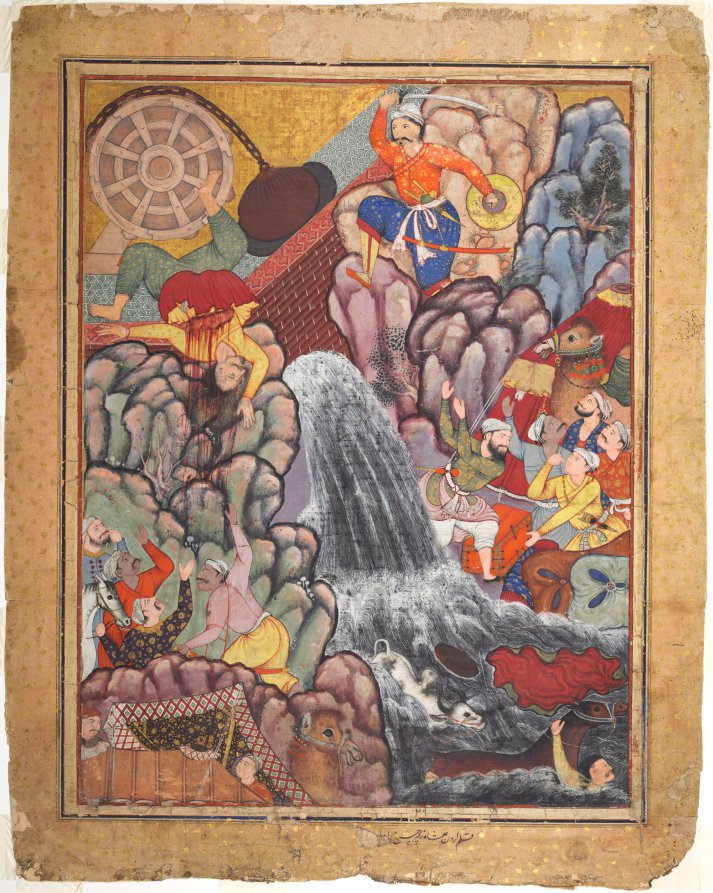
Alamshah cleaving asunder the chain of the wheel, from volume 11 of a Hamza-nama (Adventures of Hamza)
In this Mughal folio, the wheel functions as an instrument of heroic defiance, cleaved asunder by a legendary warrior, its spokes rendered with the same decorative precision as the silks and jewels surrounding the scene, marking the wheel as an object of power worthy of such violent liberation.
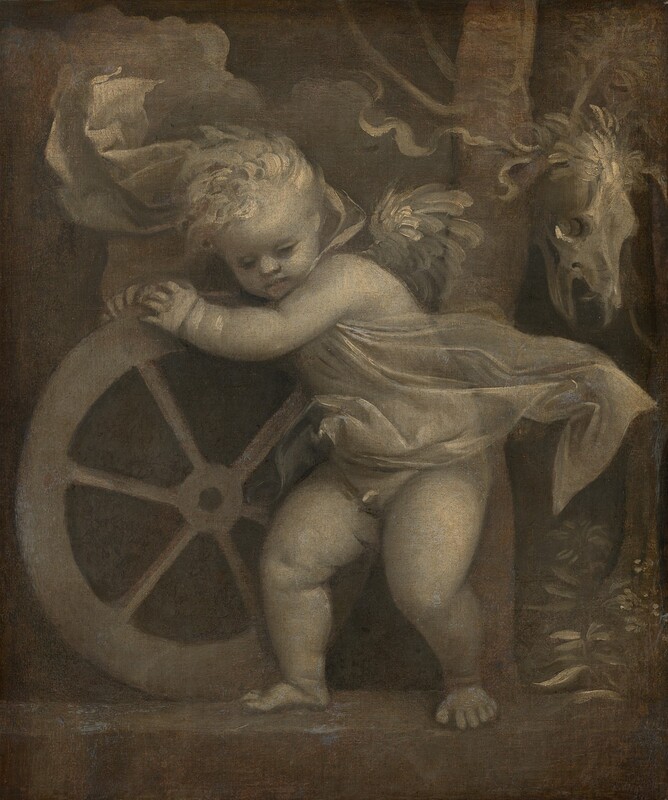
Cupid with the Wheel of Time
Titian places Cupid atop the wheel of time itself, a cherub both riding and guiding the temporal engine, conflating divine play with cosmic mechanics in oil paint's soft modeling of flesh and shadow.
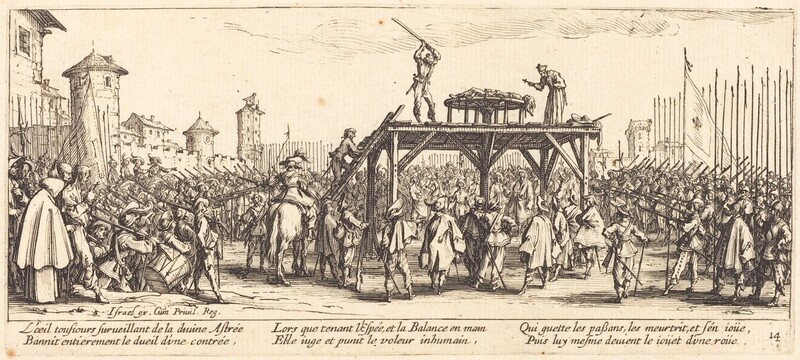
The Wheel
Callot's etching depicts the wheel as a site of public spectacle and punishment, densely populated with figures and architectural weight, the wheel's geometric clarity emerging from thousands of crossing lines that build up the visual horror of the scene.
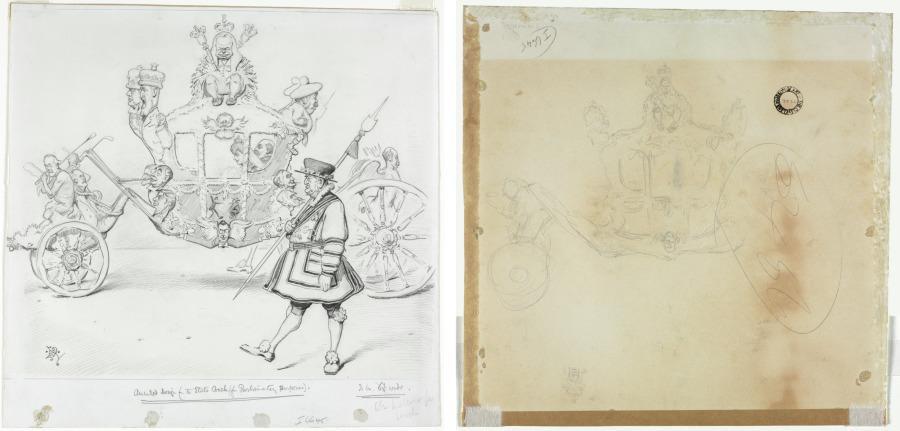
The Stagecoach for Parliamentary Purposes (recto) Study for Cab and Front Left Wheel of Coach and Study for Head of Crowned Figure Seated on Top of Coach (verso)
Reed's graphite studies for a parliamentary stagecoach capture the wheel as a detail of satirical machinery, the coaching wheel rendered alongside architectural ornament and political allegory in quick, economical line.
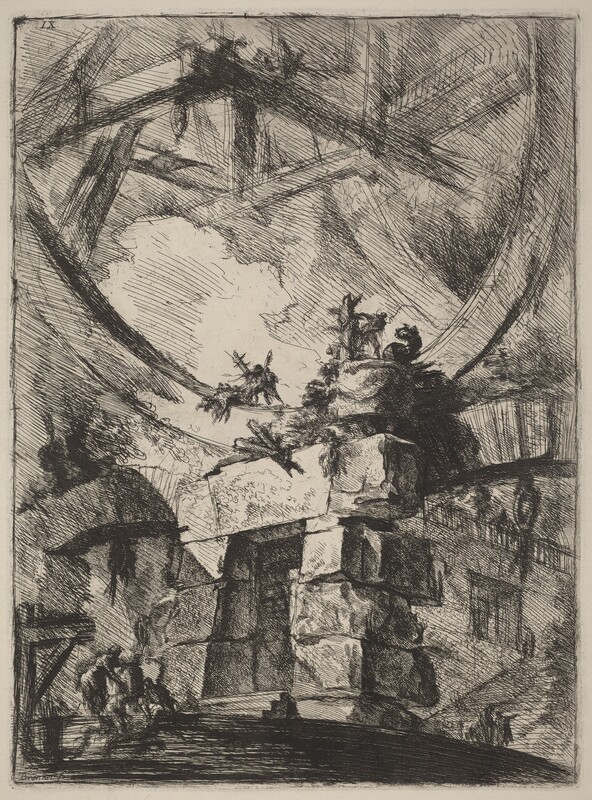
The Giant Wheel
Piranesi's monumental giant wheel dominates a cavernous interior, its spokes rendered in dense crosshatching that makes it loom like an architectural ruin, suggesting the wheel as both industrial engine and ancient monument.

The Watershot Wheel
Ibbetson's canvas depicts a working waterwheel set into a rural landscape of golden light and lush foliage, the wheel in functional operation rather than as symbol, embedded in the economic life of the countryside.
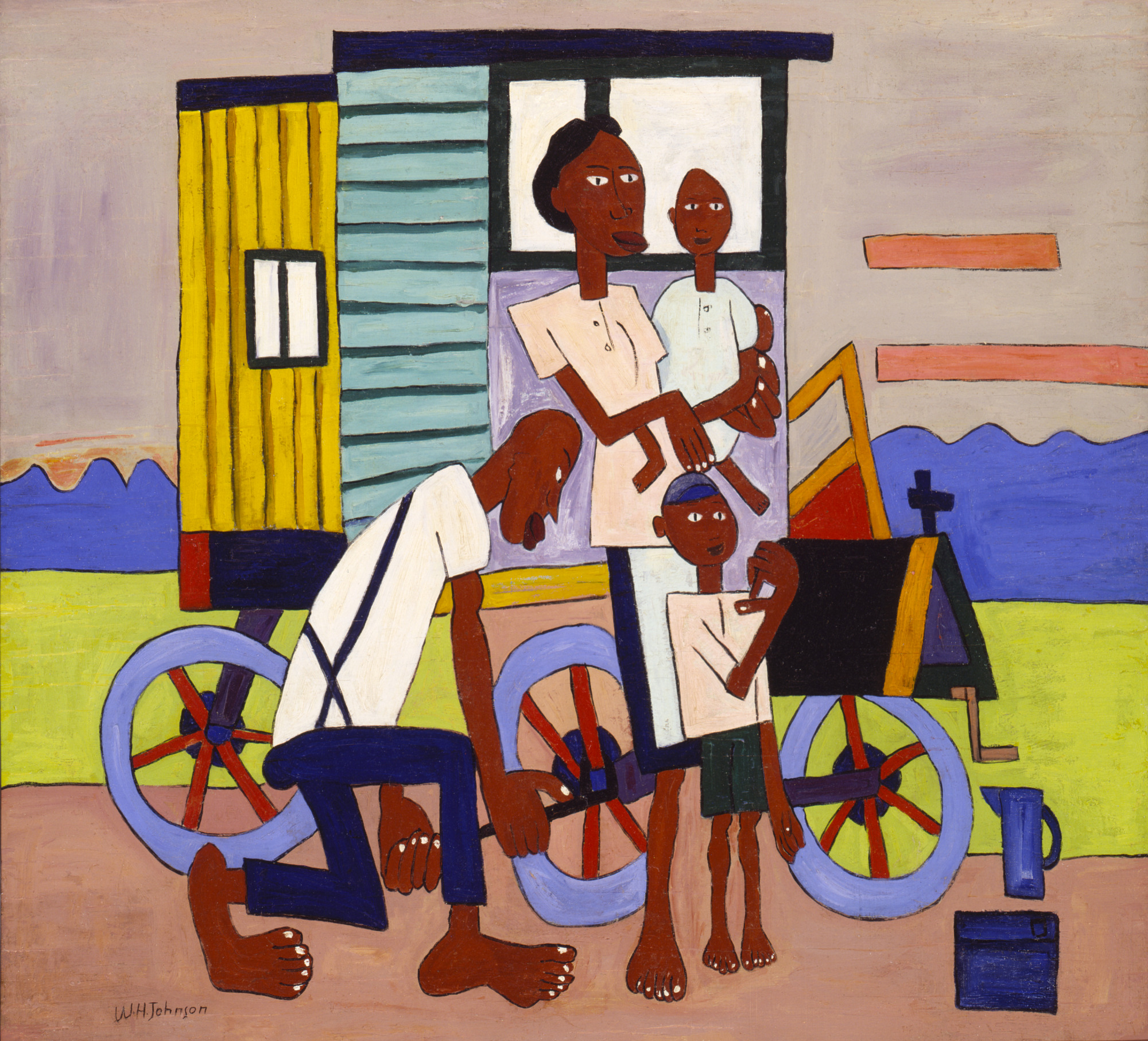
Breakdown with Flat Tire
William H. Johnson's Breakdown with Flat Tire presents the bicycle wheel not as romance but as domestic crisis, a flattened tire on a domestic machine rendered in Johnson's flattened, angular modernist forms that make the mechanical failure itself a subject.
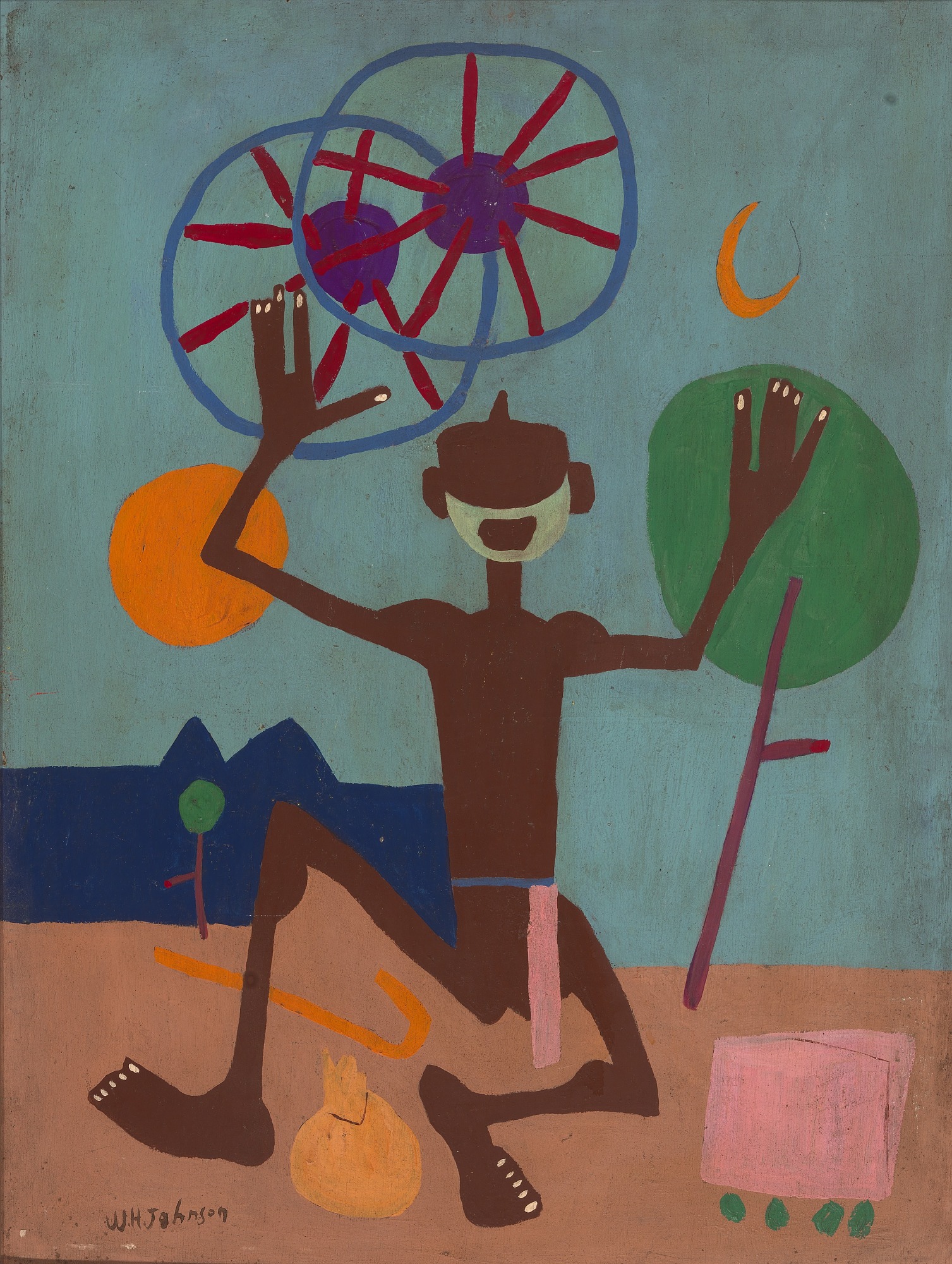
Ezekiel Saw the Wheel
Johnson's Ezekiel Saw the Wheel translates the spiritual vision of rotating wheels from scripture into his own modernist idiom, the wheels becoming geometric abstractions painted in brilliant primary colors against a weathered ground, collapsing sacred and mechanical sight.
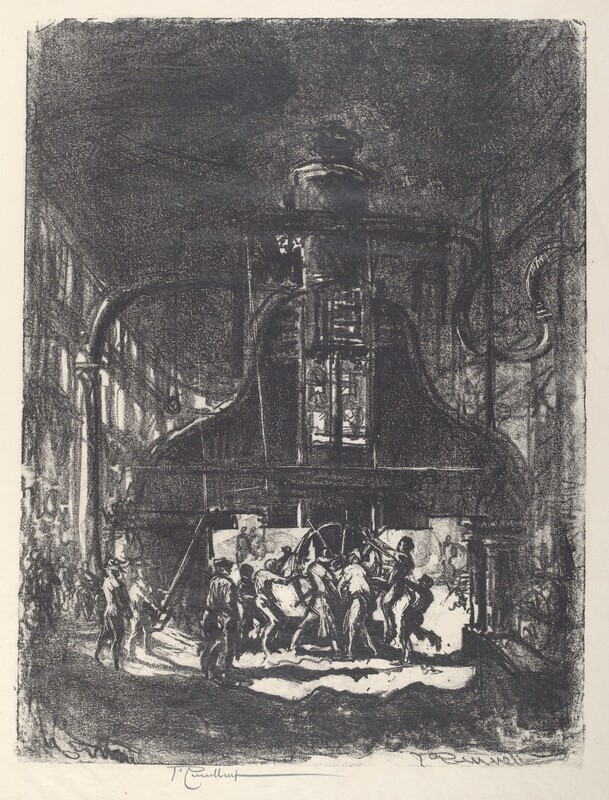
Forging Shells, The Slaves of the Wheel
Pennell's lithograph captures workers forging artillery shells beneath and around a massive industrial wheel, the title's claim of slavery rendered literally in the compressed bodies and dense crosshatching that makes the wheel and labor inseparable.
Blue Gray Violet Wheel (from series, the Mathematical Basis of the Arts)
Schillinger's Blue Gray Violet Wheel is a mathematical abstraction of circular form itself, concentric circles and overlapping arcs of tempera exploring color and depth rather than mechanical function, the wheel dissolved into pure proportion.
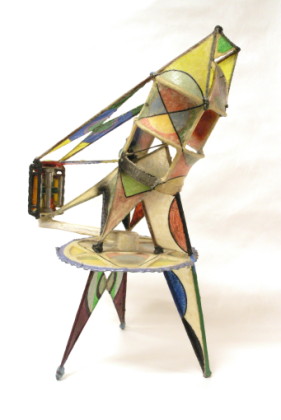
Flow Her Pedal Past
Martin Johnson's Flow Her Pedal Past assembles an actual bicycle pedal within a sculptural frame of wire, cheesecloth, and paint, making the wheel's working part a material object to be encountered rather than represented.
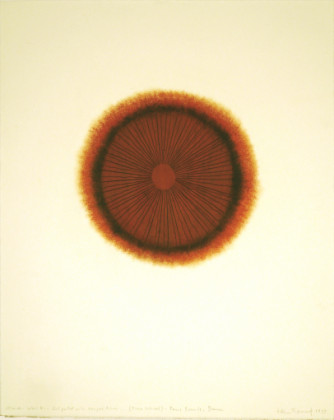
(Time Wheel) - Paris Sounds: Dawn
Renouf's Time Wheel is a burnished circular form scraped into oil pastel, its radiating lines creating both temporal and optical motion, the title and technique asserting that the wheel is a way of measuring and seeing time itself.
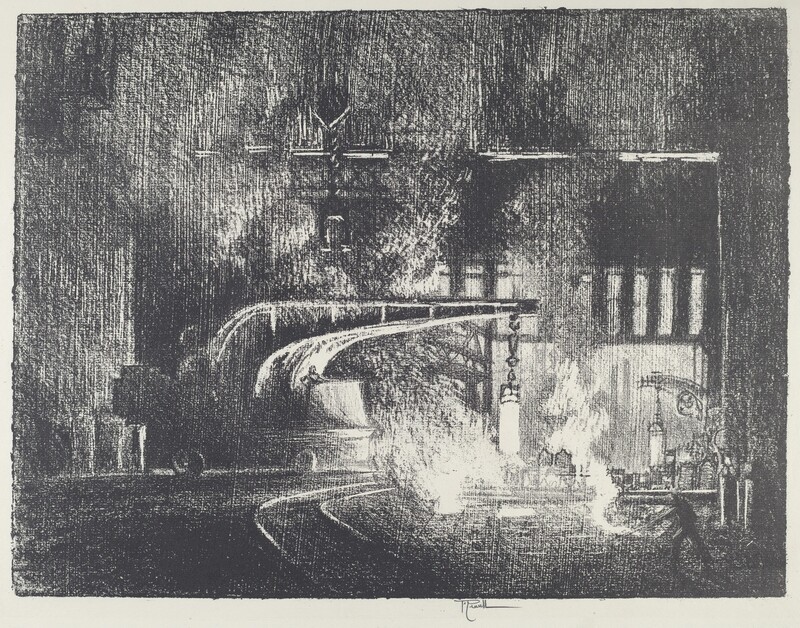
The Perambulator
Pennell's lithograph depicts The Perambulator, a wheeled carriage for a child, rendered in his characteristic dense crosshatching that transforms domestic machinery into architectural mass, the small wheel carrying its load through shadow and industrial atmosphere.
The Review

The first thing that hits you walking into this show is how rarely anyone looks at a wheel head-on. We pass them constantly. They hold our weight, move our goods, mark time. And artists, it turns out, have been staring at them for five hundred years. What they have actually made of that staring is the point.
Titian's Cupid with the Wheel of Time stops you cold. A small painting, really, but the modeling of that infant flesh against the wheel's geometric hardness creates a visual tension that the title tries to explain but the paint does the actual work. The oil builds the cherub's musculature with soft insistence while the wheel behind remains almost abstract in its formal precision. You see the problem the wheel presents: how do you paint motion? How do you paint something that is by definition not still? Titian solves it by not quite painting the wheel at all. It hovers. It is almost ornamental.
Callot's The Wheel takes the opposite approach. Every mark on that plate is there to create a surface so dense with incident that the wheel itself becomes almost lost in the crush of it. But that is the point. The wheel in Callot is not the subject. The spectacle is. The public nature of the apparatus. The etching's hatching is so thick in places it nearly obliterates the image, and yet the wheel reads clear. That is control. That is craft.
Where the show moves into the twentieth century, the problem shifts. The wheel stops being something that needs to be represented as object and becomes something you can just use. Johnson's Breakdown with Flat Tire contains an actual bicycle, or the painting of one, rendered in forms so hard-edged and simplified that it reads as almost purely formal. The flatness of the tire is the flatness of the picture plane. The mechanics are not being depicted so much as stated. It is a cleaner solution than Ibbetson's Watershot Wheel, which still wants to make the thing beautiful, to nest it in landscape and light. Ibbetson's painting is accomplished but it is also sentimental. The wheel is functional but also part of a dream of rural labor. The light says so. The foliage says so.
Piranesi's Giant Wheel is where the show really earns its space. That etching is not about the wheel as mechanism. It is about the wheel as form. The interior in which it sits is rendered in his typical cascading hatching, his favorite technique for suggesting scale and weight and time. The wheel becomes almost architectural. Almost monumental. You could spend an hour looking at how he has made those spokes read against the shadows around them, the way the crosshatching suggests not just darkness but volume, space, the actual thickness of an interior.
The real weakness here is that most of these pieces are old. The show moves through five hundred years of representation and then hits the twentieth century and largely stops. Schillinger's abstract wheel and Renouf's Time Wheel suggest that the form could still generate formal problems, but they are late additions to what is otherwise a historical survey. And a survey, no matter how well-made, is a survey. The curatorial argument, that the wheel has been a continuous preoccupation across periods, is true but also obvious. That artists have found different formal solutions to depicting it is also true. But obvious truths, however beautifully made, are still obvious. The show assembles evidence. It does not quite make a case that needed making.
- +Piranesi's Giant Wheel and Callot's The Wheel are formally magnificent, each solving the problem of depicting rotation through completely different technical means.
- +The chronological span and medium range create real visual variety, from tempera to etching to oil to mixed media sculpture.
- +Individual pairings work: Titian's Cupid next to Ibbetson's pastoral wheel creates a productive formal contrast.
- –The premise that the wheel has been an object of artistic fascination is true but does not justify the selection. Many of these pieces treat the wheel incidentally rather than as a genuine formal or conceptual problem.
- –The show leans entirely on historical works through the early twentieth century, missing an opportunity to ask whether contemporary artists are still interested in the wheel as a formal subject.
- –The wall text promises an argument about symbolic weight (labor, time, divinity, ingenuity) but the paintings themselves are primarily interested in formal representation, creating a mismatch between curatorial claim and actual visual evidence.
- Marcel Duchamp →His Bicycle Wheel (1913) transformed the wheel from a representation into an actual object and artwork, a move that this show's historical focus makes conspicuous by its absence.
- Russian Constructivism →Russian Constructivists made the wheel and mechanical form central to artistic expression as a symbol of industrial modernity and social progress, extending the twentieth-century engagement with wheels that this show barely touches.
- Fernand Léger →Léger's paintings of machines and workers throughout the 1920s-30s use wheels and cylindrical forms as the visual language of modern labor, offering a bridge between the historical survey here and modernism's embrace of mechanical form.
Curious what another critic would make of this show?